Direct Mail to 10,000 Homes: How Local Businesses Still Win Attention
How direct mail to 10,000 nearby homes still wins attention for local businesses — what the reach really means, how it compares to social and search, and how print opens a phone action.

- Direct mail is advertising delivered by USPS to every home in a defined route, so reach is a geographic fact rather than an auction outcome.
- 10,000 homes is a radius, not an audience segment — think of it as a market you can walk, not a targeting layer.
- Print earns the first three seconds. A QR code turns that attention into a phone action you can actually count.
- Measure conversations, scans, and redemptions. Ignore impressions.
- Mail is wrong for businesses with no local service radius and no capacity to answer demand.
Who this is for: Owners of businesses that serve a physical radius — restaurants, clinics, salons, trades, auto, retail — who want steady local demand instead of another content calendar.
A neighbor opens the mailbox once a day. That moment has almost no competition: a few bills, a card, one magazine. Compare that to a phone screen, where your ad is the eleventh thing in a scroll that never ends. Local attention did not disappear — it moved into places where it is expensive and short. The mailbox is one of the last places where a local business gets a full, unhurried look, and it is the reason direct mail is still a working channel in 2026 rather than a nostalgia play.
Direct mail for a local business is advertising physically delivered by USPS to every address on a defined set of postal routes. You do not bid, you do not target interests, and you are not competing for placement. You choose geography, and the geography is delivered. That single difference changes how you plan an offer, how you measure it, and who it works for.
Why local attention got harder
Three things happened at once. Organic reach on social platforms collapsed into a pay-to-play system, so a local page with real followers now reaches a fraction of them. Paid auctions filled with national advertisers who can absorb a higher cost per click than a neighborhood salon can. And search results for local queries got denser — maps, ads, aggregator sites — pushing individual businesses further down the page.
None of that makes digital useless. It makes digital a place where you compete for attention you already earned somewhere else. A neighbor who has never heard of you rarely searches for you by name. Something has to plant the name first. Mail is one of the few remaining channels where a local business can plant it at scale without an auction.
What “10,000 homes” actually means for an owner
The number sounds abstract until you turn it into a map. Ten thousand homes is a cluster of neighborhoods, not a city. In most South Florida suburbs it covers a radius people already drive inside every week — the same roads that lead to their grocery store, their kid's school, and their gas station. That matters more than the raw count, because proximity is the strongest predictor of whether a local ad turns into a visit.
Translate it into households, not impressions. One drop puts a printed page in front of thousands of decision-makers who live close enough to actually show up. Not all of them need what you sell this month. A fraction do, and a larger fraction will need it later — which is why repetition inside the same routes outperforms scattering the same budget across a wider area.
Mail vs social vs search: what each job is really for
Owners argue about channels as if one has to win. They do different jobs. Mail creates awareness inside a geography. Paid social creates interest with people who did not ask. Local search captures demand that already exists. Trying to make one channel do all three is where budgets die.
| Direct mail | Paid social | Local search | |
|---|---|---|---|
| Primary job | Awareness in a radius | Interest and interruption | Capture existing demand |
| Who sees it | Every home on the route | An algorithmic slice | People already searching |
| Cost shape | Fixed per drop | Auction, rises with competition | Time plus auction |
| Speed | Days after delivery | Hours | Weeks to months organically |
| Trust signal | High — physical, permanent | Low — skippable | Medium — depends on reviews |
| Natural tracking | QR scans, redemptions, calls | Platform-reported clicks | Calls, directions, form fills |
Read that table as a sequence rather than a menu. Mail plants the name. Search catches the person a week later when they finally type it. The businesses that get the most out of a drop are the ones whose listings and directions are already clean — a topic we cover in Get Found Locally. If you want the head-to-head version of this comparison, read Direct Mail vs Social Ads vs Local SEO.
The hybrid move: print that opens a phone action
Print alone has one weakness: the path from interest to action used to be a phone number the reader had to type. That gap is where most old direct mail leaked. A QR code closes it. The reader is already holding the phone; the scan takes under two seconds and lands them on a page you control.
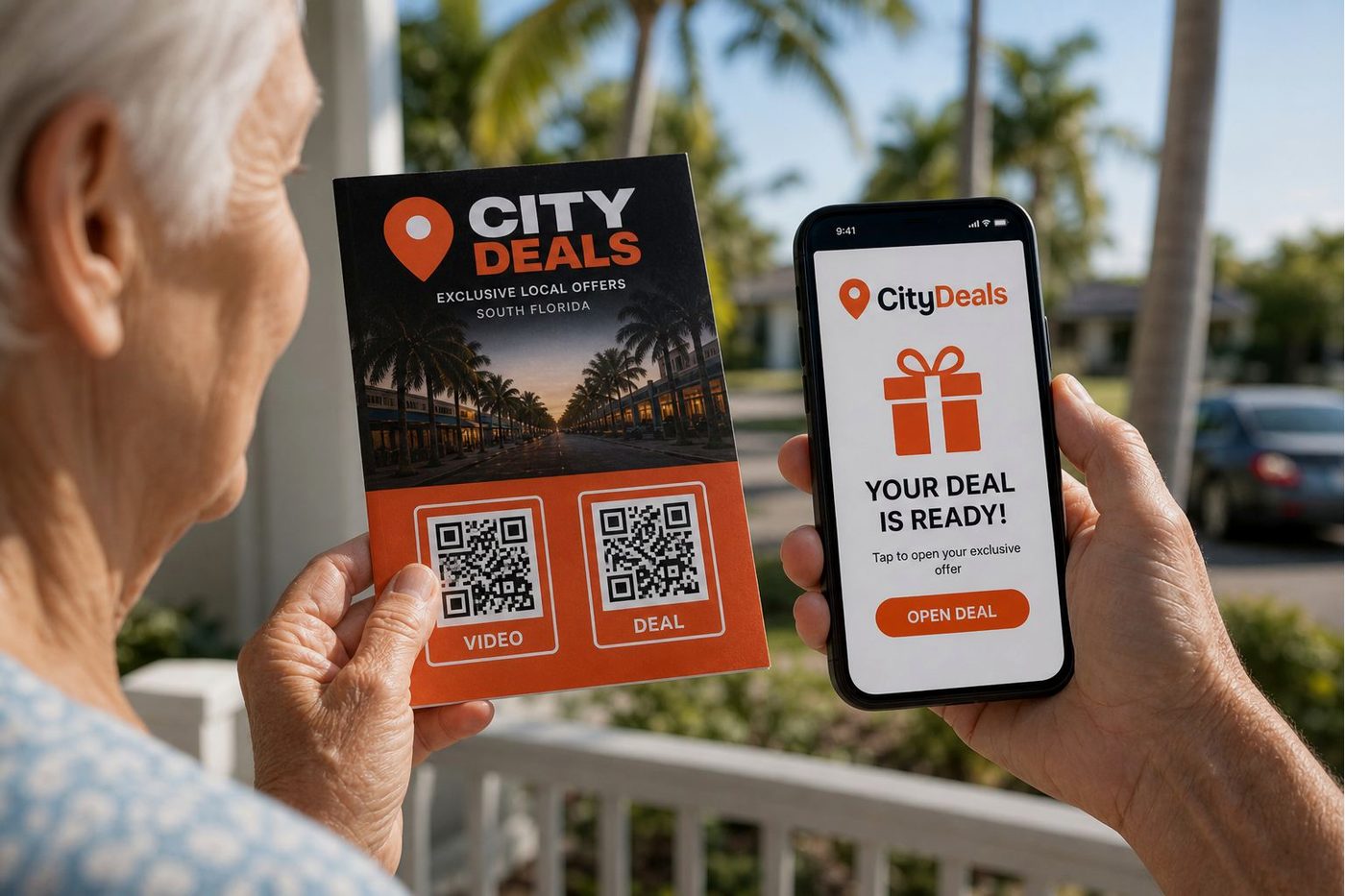
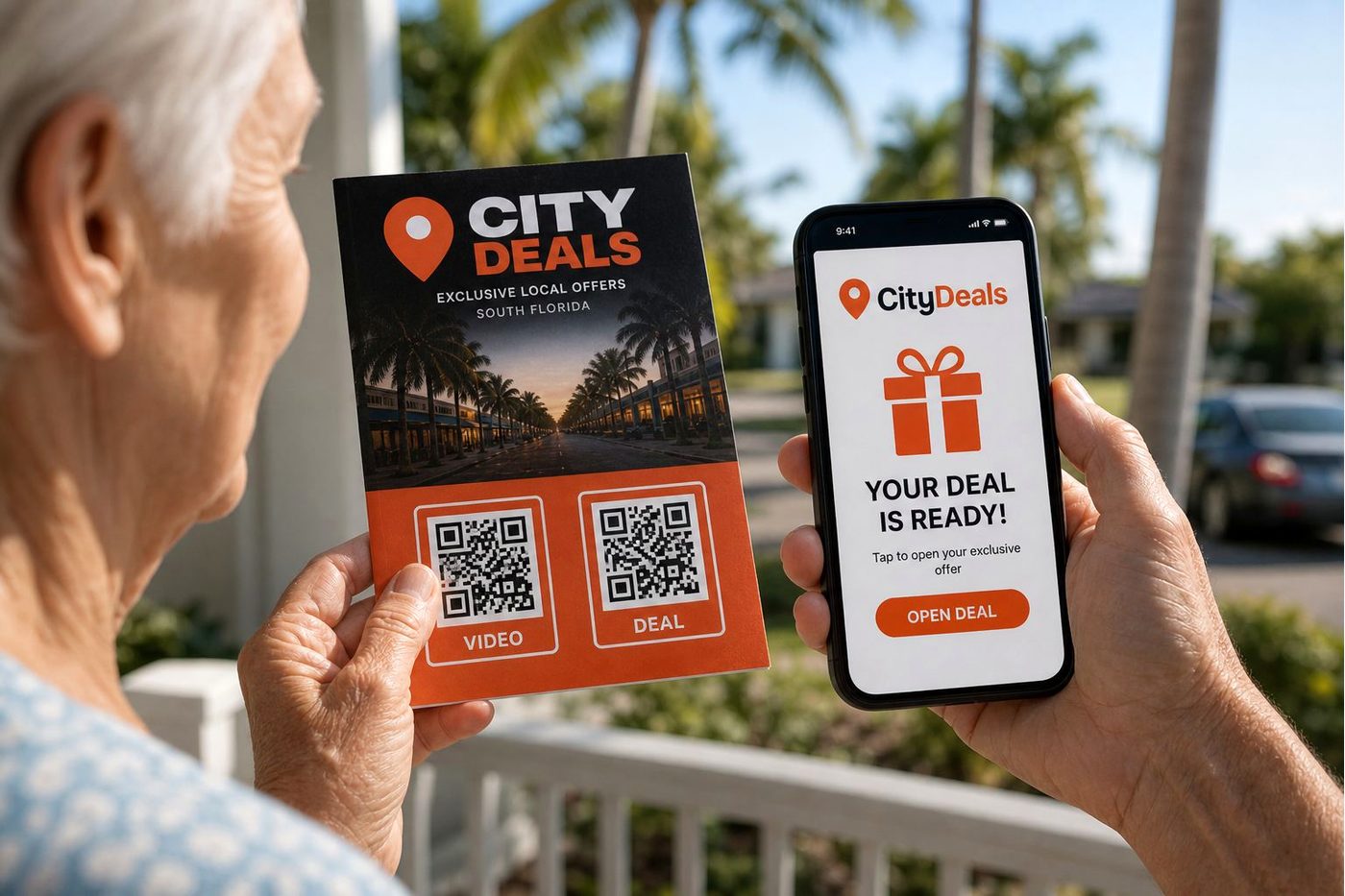
City Deals runs two codes on every ad instead of one. The first opens a short commercial — the business, the place, the feeling. The second opens a digital offer with directions, a call button, and a redeemable coupon. Splitting the paths keeps each one honest: one is for people deciding whether they like you, the other is for people who have already decided. The mechanism, and the design rules that keep scan rates up, are explained in Two QR Codes on One Print Ad.
What to put on the page (offer rules)
A page in a shared publication has one job: get a specific person to take one specific action. Not to explain everything you do. The most common failure is a page that lists twelve services, two phone numbers, and no reason to act this month.
- One offer. If you need two, you need two months.
- A concrete number or item — not “great prices”.
- A deadline or a limit, so there is a reason to act now.
- The redemption rule in plain words: what the neighbor shows, and when.
- Proof that fits on a page: years in business, license, response time, neighborhood name.
- One visual that shows the actual product or the actual room.
Offer copy is its own discipline. The full playbook, including category templates for restaurants, dental, salons, HVAC, and auto, is in How to Write a Local Coupon Offer People Actually Redeem.
How to measure without vanity metrics
Direct mail gets accused of being unmeasurable, usually by people measuring the wrong thing. You cannot count who looked at the page. You can count every action that follows it, and those are the only numbers that pay rent.
- Scans on each QR code, separated by commercial and offer.
- Redemptions — coupons actually used at the counter.
- Calls placed from the offer page.
- Direction requests, which are the strongest intent signal a local business gets.
- New customers who mention the magazine, captured by one question at intake.
Then do the arithmetic that matters: cost per conversation, and average ticket of a redeemed customer. If ten conversations cost less than one job is worth, the channel works for you regardless of what the impression math says. Track it weekly on paper if you have to — consistency beats dashboards.
- The offer is one sentence and has a limit.
- Staff know the redemption rule and can explain it in ten seconds.
- Your phone gets answered during business hours, including the week after delivery.
- Your listing address, hours, and phone match everywhere online.
- You have a place to write down where each new customer came from.
- You can handle a spike without ruining the experience.
Who should buy a drop — and who shouldn't
Mail works when the customer has to be physically near you: food, dental, salons and barbers, medspas, gyms, auto service, home services, veterinary, tutoring, local retail. It works especially well for trades, where trust and permanence matter more than clever creative — see Home Services Advertising That Gets the Phone to Ring.
It is the wrong channel for national e-commerce with no service radius, for businesses whose margin cannot survive any discount, and for anyone who cannot answer the phone for the two weeks after delivery. Honest answer: if your operation is already at capacity, spend the money on staffing first. Advertising a service you cannot deliver is the fastest way to convert a neighborhood into a bad review section.
What to do Monday morning
Write the single offer you would be happy to honor a hundred times. Draw your real service radius on a map and see how much of it 10,000 homes covers. Check that your hours and phone number are correct in every place a neighbor might look. Then tell your staff what the coupon looks like and what they should say when someone walks in holding a phone.
Frequently asked questions
Does direct mail still work for small local businesses?
Yes, when the business serves a physical radius and the ad opens a clear action. Mail's advantage is uncontested attention at the mailbox and delivery that does not depend on an auction. Its weakness — the gap between interest and action — is closed by a QR code that puts an offer, directions, and a call button on the reader's phone.
How many homes should a first campaign reach?
Enough to cover the radius your customers actually drive from. For most neighborhood businesses that is a cluster of routes rather than an entire city. Concentrating a budget inside a smaller area and repeating it beats a single wide drop.
How do you track results from a printed ad?
Track QR scans on each code, coupon redemptions, calls and direction requests from the offer page, and one intake question at the counter. Those four numbers give you cost per conversation, which is the metric to manage.
How soon do results appear after delivery?
The first responses typically arrive in the days right after homes receive the publication, then taper into a slower tail as neighbors keep the page or the saved offer. Plan staffing for the first two weeks and judge the drop over the full month.
Is direct mail expensive compared to social ads?
It has a different cost shape. Mail is a fixed cost for guaranteed delivery to a known geography; social is a variable auction cost for uncertain reach. Compare them on cost per conversation, not cost per impression.
Put your business inside 10,000 local homes.
One printed page, two QR codes, and a digital offer neighbors can use today.
Advertise your business