Is Print Advertising Dead for Local Business? (Honest Answer)
An honest answer to whether print advertising is dead for local business: what actually died, what still works, why the phone is the bridge, and a simple test plan for a single drop.
- Print is not dead for local business; undifferentiated junk print with no action path is.
- Print's durable advantage is uncontested attention and physical permanence in the home.
- Its historic weakness — no measurable path to action — is solved by a scan.
- Judge a drop on cost per conversation, not on impressions or gut feel.
- Skip print if you have no service radius, no capacity, or no offer worth acting on.
Who this is for: Skeptical owners weighing whether to spend anything on print, and anyone who has been burned by a flyer campaign before.
The question comes up in every first meeting, usually with a slightly apologetic tone: isn't print dead? The honest answer is that a specific kind of print died, loudly and deservedly, and its corpse is still shaping the reputation of everything else in the mailbox.
Print advertising is not dead for local businesses; untargeted, undifferentiated print with no path to action is. What replaced it is a hybrid: a physical page that earns attention, plus a scan that turns that attention into a measurable phone action. Judge print on that definition, not on the flyer that came with a pizza menu in 2011.
What actually died
- Cheap single-sheet flyers with a logo, a phone number, and no offer.
- Newspaper display ads sold on circulation nobody verified.
- Coupon books so dense that no individual page was ever seen.
- Campaigns with no way to know whether anything happened.
- Creative that talked about the business instead of the reader.
The common thread is not the paper. It is the absence of a reason to look and a way to respond. Digital advertising has exactly the same failure mode; it just fails invisibly, buried in a dashboard, instead of in a recycling bin where the owner can see it.
What still works
Three properties of print did not degrade, and no amount of platform change has touched them.
- Uncontested attention. The mailbox has almost no competition compared to a feed.
- Permanence. A page stays on a counter for days; an impression lasts a second and a half.
- Guaranteed geography. Delivery is a postal fact, not an auction outcome.
Those three are worth something specific to businesses whose customers must be nearby. The full reach argument is in Direct Mail to 10,000 Homes.
The phone is the bridge
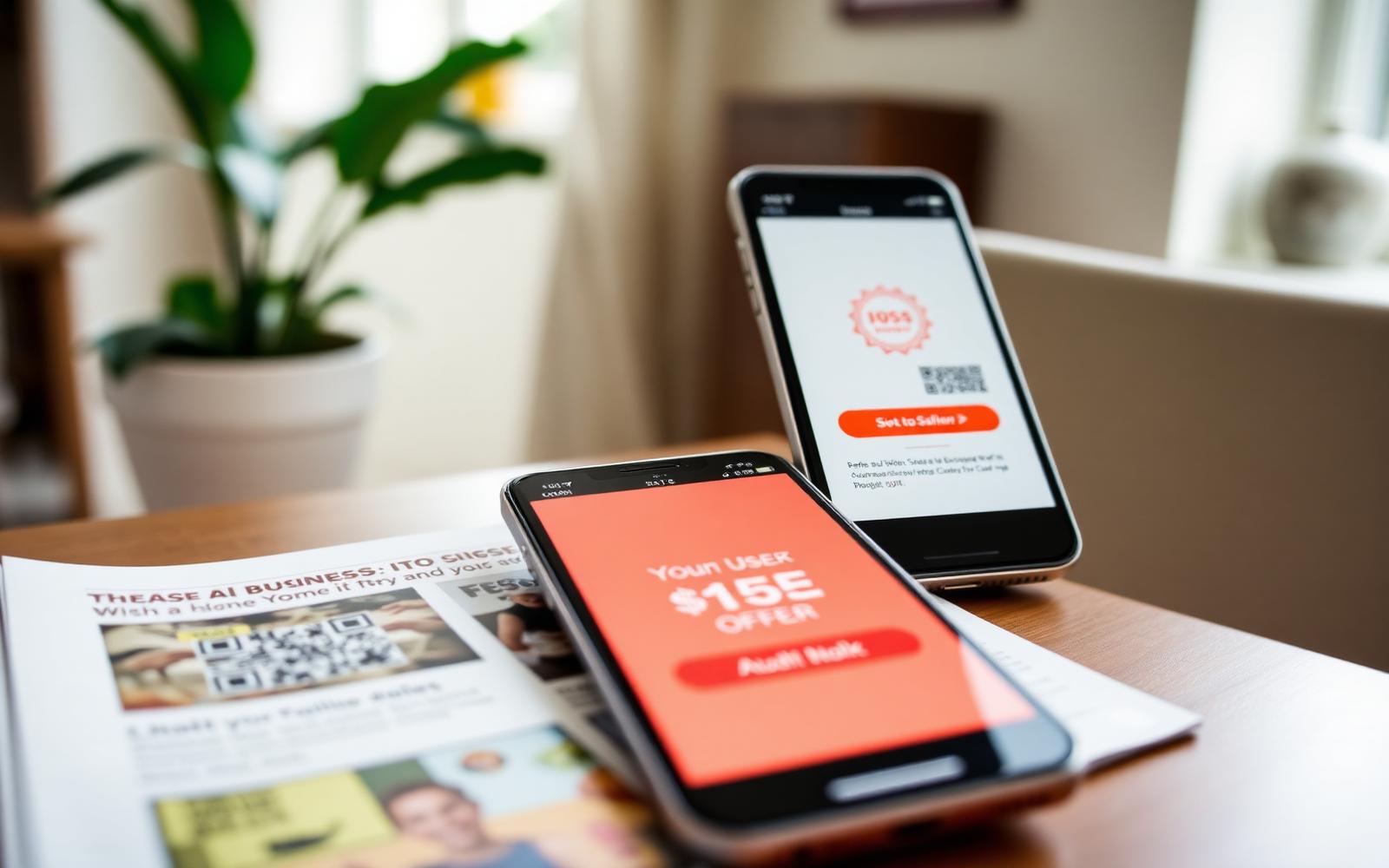
The reason this conversation is different in 2026 is that the reader is already holding the measuring device. Printing a code that opens a commercial or a redeemable offer collapses the old gap between “interesting” and “I did something”, and it produces exactly the numbers print was always accused of lacking.
Two codes work better than one, for reasons of intent rather than novelty — see Two QR Codes on One Print Ad.
Cost per conversation thinking
Impressions are a vanity unit in local business. What you actually buy is conversations: calls, walk-ins holding a phone, booked appointments. Divide total spend by that count and you get a number you can compare across every channel you run.
| Input | Where it comes from |
|---|---|
| Total spend | The invoice, including creative |
| Conversations | Calls + redemptions + booked jobs |
| Cost per conversation | Spend ÷ conversations |
| Close rate | Customers ÷ conversations |
| Average ticket | Your own POS |
| Verdict | Ticket × close rate vs cost per conversation |
The channel comparison version of this exercise is in Direct Mail vs Social Ads vs Local SEO.
A simple test plan for one drop
- Pick one offer you would be glad to honor a hundred times.
- Pick the routes that match your true service radius.
- Print two labeled codes: commercial and offer.
- Brief staff and post the redemption rule at the counter.
- Log scans, redemptions, calls, and direction requests for 30 days.
- Ask every new customer one question about how they found you.
- Compute cost per conversation and compare it to your average ticket.
- Decide on the numbers, not on the first quiet Tuesday.
When to skip print
Being honest about this matters more than selling a page. Skip it if you sell nationally with no radius, if your margins cannot survive any promotional offer, if you are already at capacity, or if you cannot answer the phone reliably for the two weeks after delivery. In those cases print will produce demand you convert into disappointment.
Skip it too if you have not fixed your listings. A drop that sends neighbors to a wrong address is a paid apology — start with Get Found Locally.
What to do Monday morning
Decide the number that would make a drop worth it — how many new customers, at what ticket. Write it on a sticky note. Then run one test drop with real tracking and compare the note to reality. That is a better answer to “is print dead” than any article, including this one. If you want the test built for you, talk to City Deals.
Frequently asked questions
Is print advertising dead?
No, but a specific kind of print is: untargeted flyers with no offer and no way to respond. Print that earns attention and opens a measurable phone action still performs for businesses that serve a physical radius.
Does direct mail still work in 2026?
For local businesses, yes. It provides uncontested attention at the mailbox, physical permanence in the home, and delivery guaranteed by geography rather than an auction — and QR codes now make the response measurable.
How do I test print without wasting money?
Run one drop with one clear offer, two labeled QR codes, and a 30-day log of scans, redemptions, calls, and direction requests. Then compute cost per conversation and compare it to your average ticket and close rate.
When is print the wrong choice?
When you have no local service radius, no margin for any offer, no capacity to serve more customers, or inaccurate listings and an unanswered phone. Fix operations before buying attention.
Why do people say print does not work?
Usually because they ran undifferentiated creative with no offer and no tracking, so they had no way to see what happened. The same campaign design fails in digital; it just fails less visibly.
Put your business inside 10,000 local homes.
One printed page, two QR codes, and a digital offer neighbors can use today.
Advertise your business