Two QR Codes on One Print Ad: Commercial + Offer Explained
Why a print ad should carry two QR codes instead of one: a commercial path that builds trust and an offer path that gets redeemed. Design rules, mistakes, and how to track scans.
- A single generic QR forces one page to serve two different readers and usually serves neither.
- QR A carries the commercial: who you are, what the place feels like, why you are credible.
- QR B carries the offer: a redeemable coupon plus directions, call, website, and social.
- Scan rate is a design problem — size, contrast, quiet zone, placement, and a label that says what happens next.
- Track scans by code so you learn whether people need convincing or just a reason to move.
Who this is for: Owners and designers building a print ad who want the page to produce measurable phone actions instead of decoration.
Most printed QR codes fail for a boring reason: nobody told the reader what happens after the scan. A bare square in a corner is a coin flip, and readers do not gamble two seconds of their day. The fix is not a bigger code. It is being specific — and being specific usually means you need two codes, because a print ad is read by two different people at once.
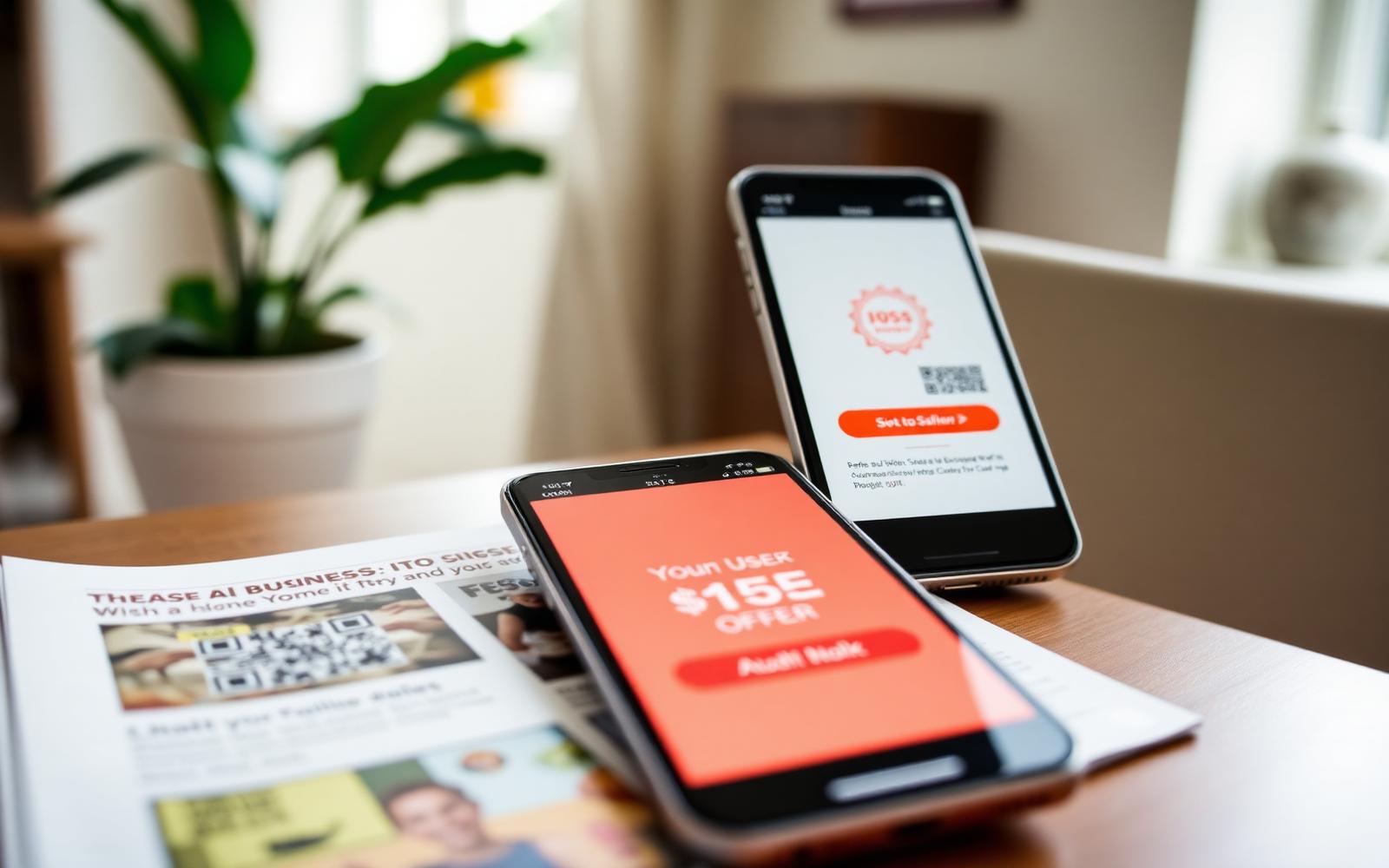
Two QR codes on one print ad means splitting the scan into two intents: one code opens a short commercial for readers who are still deciding, and one opens a redeemable digital offer for readers who already are. Each code has its own label, its own landing page, and its own scan count. That is the whole mechanism, and it is the reason City Deals prints two codes on every advertiser page.
The problem with one generic QR
One code has to point somewhere. Point it at your homepage and the interested reader lands on a navigation menu instead of an answer. Point it at a coupon and the skeptical reader — who has never heard of you — gets asked to claim a discount from a stranger. Either way, one of the two readers bounces.
There is a second failure that is harder to see. With one code you get one number, and that number cannot tell you why the ad worked or didn't. Two hundred scans means nothing on its own. Two hundred commercial scans and eleven offer scans tells you the creative is interesting but the offer is weak. Eleven commercial scans and two hundred offer scans tells you the opposite.
QR A: the commercial path
The first code opens a short video commercial. Its job is trust, not conversion. The neighbor sees the room, the people, the food, the truck, the chair — the physical reality behind the printed page. For a business nobody has visited yet, that is the difference between a name and a place.
- Keep it short. Attention on a scanned page is measured in seconds, not minutes.
- Show the actual location in the first frames. Recognition beats production value locally.
- Show a person. Trades and clinics especially: neighbors hire faces.
- End on the same offer that appears in print, so the two paths agree.
- Make the page load fast on cellular in a driveway, not just on office Wi-Fi.
QR B: the offer path
The second code skips the story. It opens a digital offer page with the coupon, a redeem action, and the rails that turn interest into arrival: directions, click-to-call, website, and social links. No menu, no scrolling to find the point.
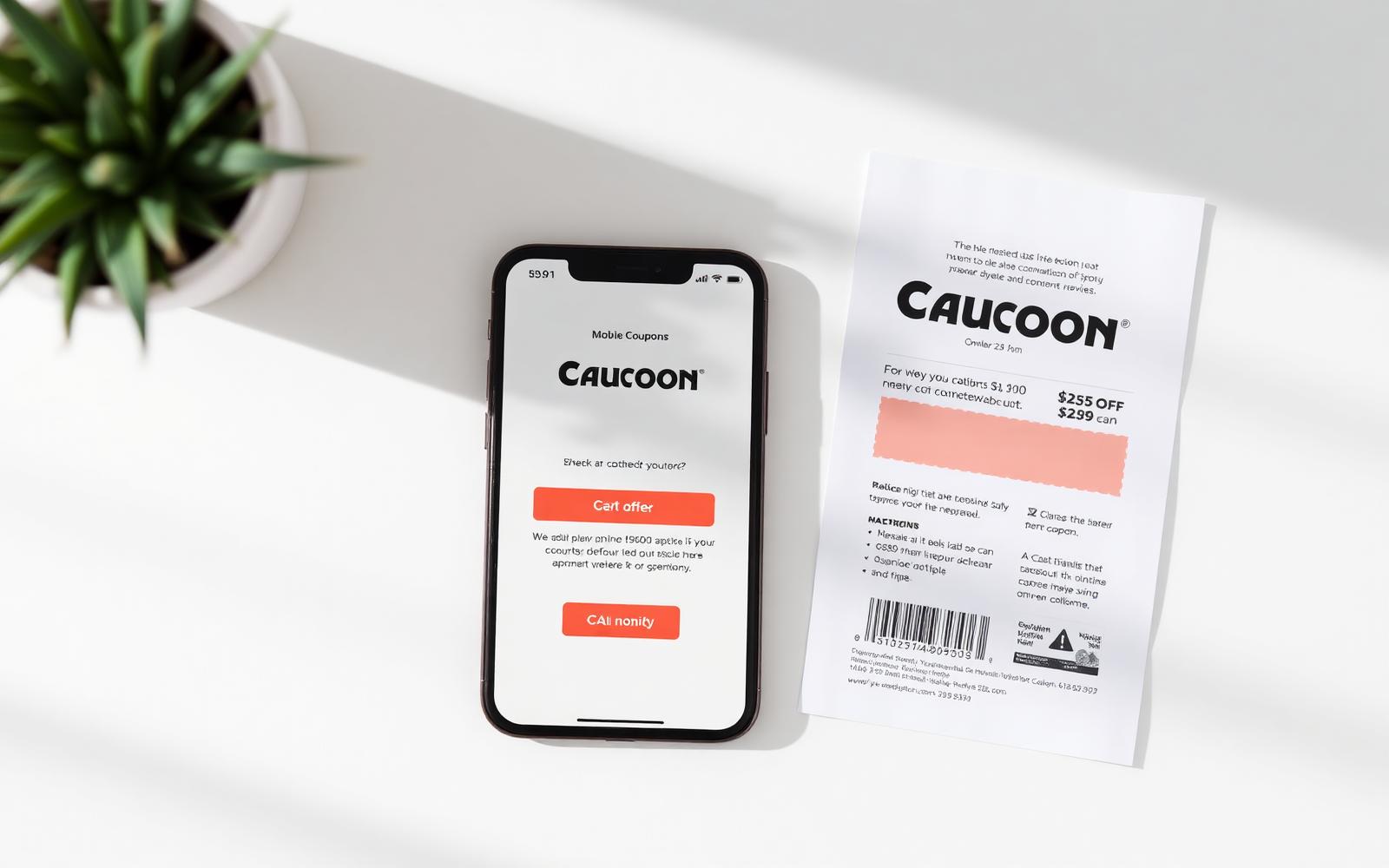
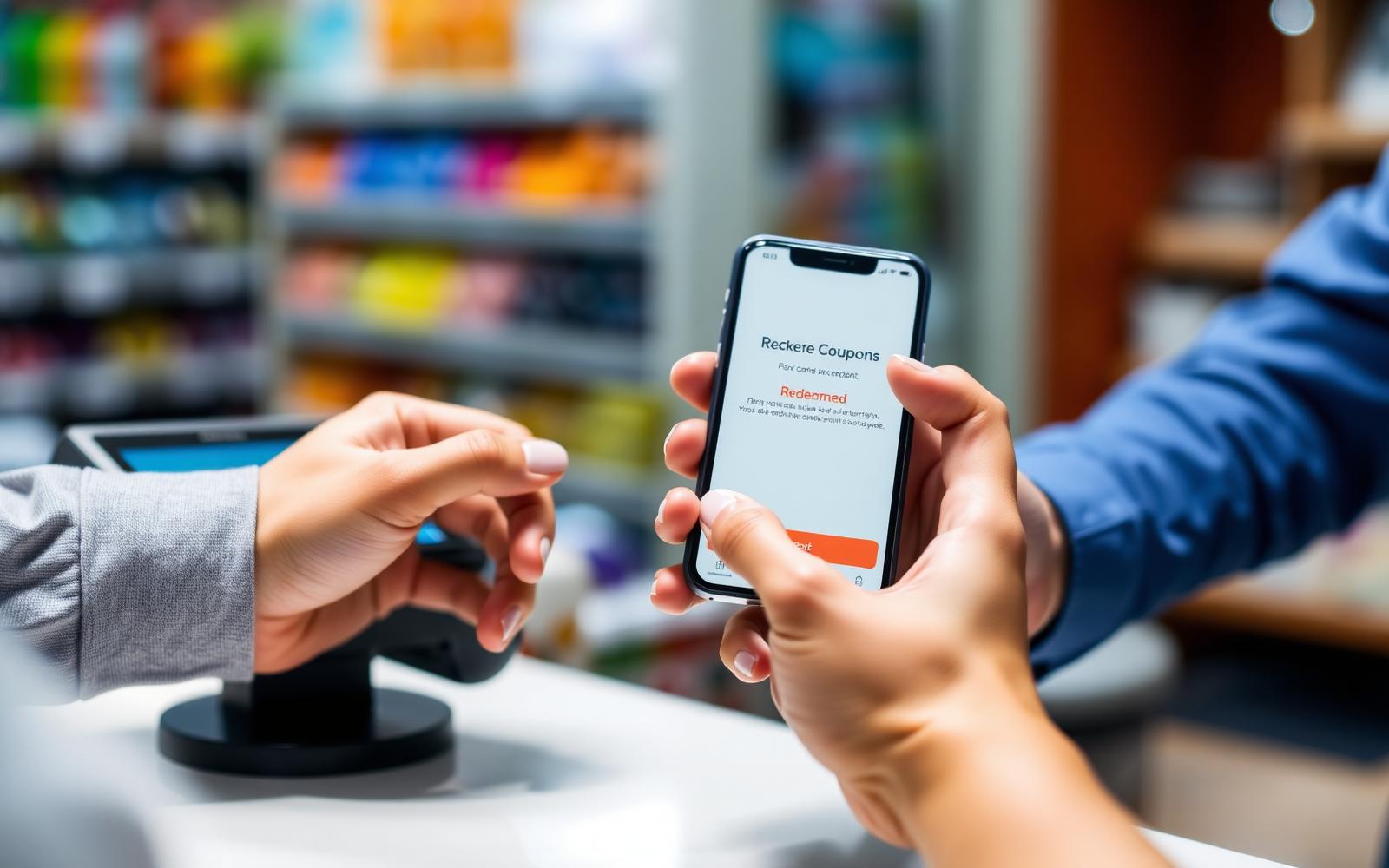
This page is also where the offer stops being a piece of paper. It can be saved to the phone, shared with a neighbor, and redeemed once at the counter. That last part protects your margin — the mechanics are covered in Digital Coupons: Save, Share, and Redeem Once.
What the neighbor should feel in three seconds
Three seconds is the honest budget. In that window the page has to answer three questions: what is this, is it near me, and what do I get. If your ad answers them before the reader decides whether to scan, the scan becomes a confirmation instead of a risk.
| Reader state | What they want | Which code | Label to print |
|---|---|---|---|
| Never heard of you | Proof you are real | QR A | Watch our 30-second story |
| Interested, not ready | A reason to choose now | QR A then B | See the place, then claim |
| Ready to buy | The deal and directions | QR B | Claim the offer |
| Existing customer | Fast repeat action | QR B | Save this offer |
Design rules: size, contrast, placement
Scan rate is mostly physics. A code that is too small, too low-contrast, or crowded by other ink will not read reliably in a kitchen at 7 p.m. under a single warm bulb.
- Print each code at least 0.8 in / 2 cm square. Bigger if the page is busy.
- Keep a clear quiet zone around each code — roughly four modules of empty paper.
- Dark code on a light background. Never invert, never place over a photo.
- Never overlap the two codes' quiet zones; separate them clearly on the page.
- Give each code its own label above or below it in plain language.
- Place them in the lower third, where a thumb naturally holds the page.
- Use a matte or uncoated area if possible; glare on gloss kills reads.
Mistakes that kill scan rate
- No label. “Scan me” is not a label; it is a shrug.
- A code that points to a homepage and forces the reader to hunt.
- A landing page that is not built for a phone.
- A code that expires and dead-ends after the campaign, teaching neighbors not to scan you again.
- Two codes that lead to the same place, which trains readers that the labels are lies.
- Requiring an app download or an account before the offer is visible.
Tracking scans without creepy claims
You should know how many people scanned each code, how many claimed the offer, and how many redeemed it at the counter. That is enough. You do not need to know who they are, and pretending you do makes neighbors uneasy in a market where word travels down a street.
Compare the two codes over time instead of chasing a single week. A rising commercial-to-offer ratio means your creative is doing its job and the offer needs sharpening — start with How to Write a Local Coupon Offer People Actually Redeem. A flat total scan count usually means the print design is the bottleneck, not the funnel.
- Both codes scanned successfully from a printed proof, not a screen.
- Both scanned in low light and at arm's length.
- Each code has a distinct label and a distinct destination.
- Offer page shows the deal above the fold on a small phone.
- Call and directions work from the page in one tap.
- Destination pages stay live after the campaign ends.
What to do Monday morning
Print your current ad, hand it to someone who has never seen it, and watch where their thumb goes. If they hesitate before scanning, your labels are the problem. Fix the words before you touch the layout, then check that both destinations load in under two seconds on cellular. If you are still deciding whether print belongs in your mix at all, read Is Print Advertising Dead for Local Business? and the 10,000-homes overview.
Frequently asked questions
Why put two QR codes on one ad instead of one?
Because a print ad is read by two different people: one who needs proof you are real and one who is ready to act. A commercial code serves the first, an offer code serves the second, and separate scan counts tell you which side needs work.
How big should a QR code be on a printed page?
At least 0.8 inches (2 cm) square, dark on light, with a clear quiet zone of empty paper around it. Increase the size if the surrounding layout is dense or the paper is glossy.
Do people actually scan QR codes in 2026?
Yes, when the label states what happens next and the destination is worth two seconds. Scanning behavior became routine at restaurant tables and checkout counters; the failure cases are unlabeled codes and slow, unhelpful landing pages.
Should both codes point to the same page?
No. Identical destinations remove the reason to print two codes and destroy the diagnostic value of separate scan counts. Give each code its own page and its own promise.
What should the offer page contain?
The offer itself above the fold, a single claim action, then directions, click-to-call, website, and social. Nothing that requires an account or an app before the deal is visible.
Put your business inside 10,000 local homes.
One printed page, two QR codes, and a digital offer neighbors can use today.
Advertise your business